What Every Parent Should Know About Online Safety for Kids: Bullying Prevention and School Safety Programs
Keeping children safe online goes beyond setting rules or limiting screen time. At GET SAFE, we provide personal safety classes across California, including Los Angeles, Long Beach, and Anaheim, with practical curricula covering bullying prevention and school safety.
Through interactive, age-appropriate lessons, children learn to recognize risks, respond to threats, and build confidence. Our violence prevention training and trauma-informed safety education guide parents, educators, and service providers on practical steps to support children safely and consistently.

Recognizing Online Threats to Kids
Most young people use the internet daily, and many teens report being online almost constantly, while younger children average multiple hours of screen time per day. These patterns create both learning opportunities and exposure to online risks. At Get Safe, we work with parents, educators, and youth organizations to highlight the risks children may encounter online and help families take practical steps to protect them.
Common Online Threats
Children face multiple online threats, each with potential long-term consequences:
Cyberbullying and harassment:Kids may experience teasing, threats, or embarrassing messages on social media, gaming platforms, or messaging apps. Research links persistent online harassment to poorer mental health, including reduced self-esteem, disrupted sleep, depressive symptoms, and elevated suicide risk in some adolescents.
Inappropriate content and media exposure: Children can accidentally or intentionally access content unsuitable for their age, including violent, sexual, or graphic material. Exposure may influence behavior, trigger anxiety, or normalize unsafe conduct.
Online predators and scams: Some adults and scammers attempt to exploit children through chat platforms, social media, or gaming networks. These interactions can lead to grooming, financial fraud, or attempts to meet in person.
We advise parents to combine monitoring with education using evidence-based steps such as family media plans, clear rules about device-free times and locations, age-appropriate restrictions, and teaching children how to use reporting and blocking tools. This protects children while preserving learning. Clear conversations, boundary setting, and age-appropriate restrictions create safer online experiences.
Signs Your Child May Be at Risk
Children don’t always report online challenges, but subtle changes can reveal problems:
Behavioral changes or emotional withdrawal: Quietness, anxiety, or irritability after device use.
Secrecy online: Password protection, reluctance to share activity, or sudden avoidance.
Changes in school or social life: Drops in grades, loss of interest in friends, or withdrawal from activities.
Observing these patterns and maintaining open conversations helps children develop safe online habits. At Get Safe, we guide families and educators with practical strategies to create safer digital environments.
Relevance to Los Angeles–Long Beach–Anaheim
With a large and diverse population of children and teens, the Los Angeles–Long Beach–Anaheim area faces unique online safety challenges.
Schools and families benefit from local programs that address cyberbullying, digital risks, and trauma-informed safety, helping children navigate both online and offline spaces confidently.
Role of Parents in Promoting Safe Online Practices
Parents play a central role in guiding children toward safe and responsible online habits. At Get Safe, we work closely with families to provide tools, strategies, and guidance that help children enjoy the benefits of digital spaces while reducing risks.
Setting Boundaries and Rules
Clear rules and limits help children navigate online activities with confidence:
Age-appropriate screen time limits:Setting daily or weekly limits on device use helps children balance online activities with homework, sleep, and physical play.
Clear behavior expectations: Discussing what is acceptable online, such as language, content sharing, and respectful communication, gives children a framework for safe interaction.
Responsible social media use: Teaching children to think before posting, avoid oversharing personal information, and interact kindly online can prevent conflicts and exposure to inappropriate content.
Open Communication Without Fear
A trusting relationship makes children more likely to share challenges they face online:
Reporting uncomfortable interactions: Children should feel safe telling you if someone messages them in a threatening, confusing, or inappropriate way.
Consequences of online actions: Talking about the effects of digital behavior, such as sharing personal details or spreading rumors, helps children recognize their responsibilities.
Active listening strategies: Paying close attention, asking clarifying questions, and validating your child’s feelings foster honest conversations without judgment or criticism.
Monitoring Tools and Resources
Using practical tools supports parents in guiding children online:
Parental control software:Programs that filter content, set screen limits, or track usage can help families maintain oversight while respecting independence.
Safe app and website selection: Reviewing apps, games, and websites before children use them reduces exposure to harmful content.
Collaboration with school staff: Teachers and administrators can offer guidance, reinforce digital safety lessons, and provide resources for families.
Combining open communication with clear rules and thoughtful monitoring helps children develop habits that keep them safer online. Families that stay involved and attentive to digital activity create an environment where children feel confident exploring online spaces responsibly.
How Bullying Prevention Programs Support Online Safety
Parents can play an active role in keeping children safe online by enrolling them in bullying prevention programs.
At Get Safe, our programs in Los Angeles, Long Beach, and Anaheim combine digital safety lessons with social skills and self-advocacy to help children handle online challenges confidently.
Key Benefits for Children:
Recognize cyberbullying: Children learn to identify harmful messages, posts, or online behaviors that may affect their well-being.
Respond safely: Programs teach strategies for calmly addressing teasing, rumors, or threats while seeking help when needed.
Build resilience: Activities focus on coping skills, confidence, and positive peer interactions online.
Practice digital responsibility: Kids develop habits for respectful communication and safe engagement across apps, social media, and online games.
How Parents Can Support:
Reinforce lessons at home: Discuss online interactions and encourage children to share concerns openly.
Coordinate with schools: Stay connected with teachers, counselors, and administrators to create consistent messages about digital behavior.
Enroll in professional programs: Get Safe offers expert-led sessions designed to teach practical, trauma-informed online safety skills.
By taking these steps in Los Angeles, Long Beach, and Anaheim, parents can help children navigate digital spaces safely, fostering confidence, responsibility, and awareness in online interactions.
Violence Prevention Training for Children
At Get Safe, we include violence prevention training to help children recognize, respond to, and avoid potentially risky situations, both online and offline. This complements our bullying prevention and school safety programs.
How Online Activities Can Lead to Risky Situations:
Interacting with strangers: Children may chat with unknown people in games or social platforms, creating opportunities for grooming or scams.
Sharing personal information: Posting sensitive details like location or school can expose them to unsafe contacts.
Exposure to aggressive behavior in games: Competitive or violent online games can lead to conflicts or desensitize children to risky behavior.
Clicking on unsafe links or content: Accidental exposure to harmful or misleading material can put children at risk.
Key Components of Our Training:
Safe response strategies: Children learn to stay calm, remove themselves from risky situations, and contact trusted adults immediately.
Practical exercises: Role-playing scenarios allow children to practice handling online and offline challenges confidently.
Peer support and advocacy: Students learn to encourage friends to make safe choices and report concerning behavior.
How Parents Can Support:
Discuss online risks and reinforce safe practices at home.
Practice response strategies together to boost confidence.
Work with schools and instructors to maintain consistent safety guidance.
This violence prevention training helps children identify online risks, avoid unsafe situations, and develop confidence in navigating both digital and real-world challenges responsibly.
Personal Safety Classes
Children can encounter unexpected risks in everyday life and online. GET SAFE’s Personal Safety 101 course teaches them to recognize threats, respond appropriately, and build confidence in managing safety challenges.
How Online Activity Can Lead to Risky Situations:
Accepting friend requests from strangers on social media or gaming platforms.
Engaging in private chats with unknown contacts.
Participating in online games with inappropriate or harmful content.
Sharing personal information, such as location or school details, with unknown individuals.
What Children Learn in the Course:
Identifying potential threats in both real-world and digital environments.
Practical strategies to avoid or safely respond to risky situations.
Setting and maintaining healthy boundaries with peers and online contacts.
Accessing trusted adults or authorities when safety is compromised.
Building self-confidence to make smart decisions under pressure.
GET SAFE tailors these personal safety classes in California for schools, community programs, and families across California. While it focuses on awareness and proactive safety, physical self-defense is offered in a separate Personal Safety & Self-Defense course.
In Los Angeles, Long Beach, and Anaheim, by participating in Personal Safety 101, children gain practical skills to navigate both online and offline spaces safely, empowering parents to feel confident in their child’s safety knowledge.
Importance of School Safety Programs
School safety programs help children feel secure while learning and interacting with peers. We focus on creating a supportive environment where students can grow academically and socially without fear of harm.
Creating a Safe Learning Environment
A safe school starts with clear policies and trained staff.
Policies for online safety and anti-bullying: Schools set rules that define acceptable behavior on digital platforms, including social media and messaging apps. Students learn what is safe, respectful, and appropriate online.
Staff training: Teachers, counselors, and administrators are trained to identify bullying, harassment, or unsafe digital interactions. They also practice responding to incidents quickly and calmly.
Practical applications: Safety drills, role-playing, and discussions give staff and students tools to react effectively in challenging situations.
Benefits for Parents and Students
School safety programs help create positive outcomes for the entire school community.
Reduced stress for families: Parents feel more confident knowing their children are learning skills to handle challenges safely.
Confidence and independence for children: Students gain self-assurance, make responsible choices, and build trust with adults at school.
Community culture: A structured approach to safety strengthens relationships between students, staff, and families, fostering a supportive environment both in school and at home.
By combining policy, training, and personal safety classes, schools provide students with the skills and guidance to navigate both real-world and digital challenges confidently.
Trauma-Informed Safety Education for Children
Children learn best in an environment where they feel safe and supported.Trauma-informed safety education helps students develop protective skills while acknowledging their emotional experiences and personal challenges.
Knowing Trauma and Its Impact
Trauma from bullying, online harassment, or unsafe interactions can affect a child’s emotional well-being and learning.
Mental health effects: Anxiety, withdrawal, or irritability may appear after repeated negative experiences online or at school.
Behavioral signals: Children might avoid devices, resist talking about certain topics, or show changes in friendships and participation.
Observation matters: By paying attention to shifts in behavior, parents and educators can recognize signs that support may be needed.
Teaching Safety Without Inducing Fear
Children respond better to safety lessons that balance awareness with reassurance.
Practical approaches: Role-playing scenarios, guided discussions, and interactive exercises give children tools to handle challenges confidently.
Awareness without anxiety: We focus on teaching students how to identify risks and respond calmly instead of creating fear of the world.
Positive reinforcement: Encouraging children for thoughtful actions helps them internalize safe habits naturally.
Supporting Vulnerable Populations
Some children need additional guidance to apply safety skills effectively.
Special considerations: Students with learning differences or disabilities may need instructions adapted to their pace and comprehension style.
Collaboration: Working with counselors, service providers, and families allows us to create consistent, supportive messaging that reinforces lessons across environments.
Inclusive learning: Activities are designed to be accessible for all children, promoting confidence and participation without singling anyone out.
By combining sensitivity, practical exercises, and collaboration,trauma-informed safety education gives children the ability to protect themselves, support their emotional well-being, and build confidence to overcome challenging situations.
Practical Steps Parents Can Take Today
Daily Check-Ins: Talk each day briefly about your child’s apps, games, and online interactions.
Reinforce Digital Etiquette: Remind children to communicate respectfully and protect personal information.
Encourage Screen Breaks: Balance device use with offline activities to reduce exposure to negative content.
Participate in School Programs: Attend meetings, workshops, or safety initiatives to support ongoing school policies.
Engage in Community Programs: Use local bullying prevention programs for schools to teach children responsible online behavior.
Collaborate with Educators: Work with teachers and other parents to make safety a shared responsibility.
Enroll in Expert-Led Programs: Trauma-informed sessions teach risk recognition, safe responses, and confidence building.
Use Tailored Workshops: Age-appropriate programs allow children to practice real-world scenarios under supervision.
Leverage Ongoing Support: Apply program resources at home to reinforce lessons and maintain consistent messaging.
Impact of Safety Training: Trained vs. Untrained
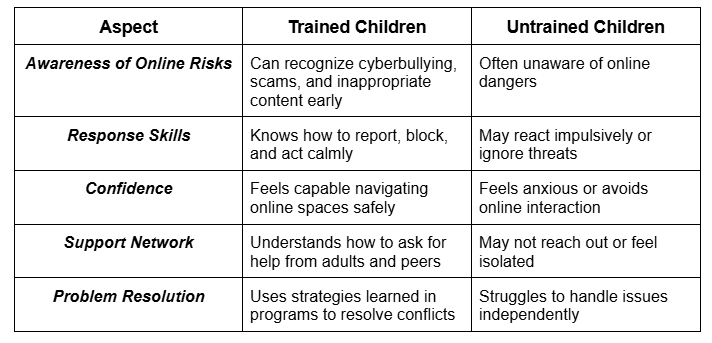
Evidence shows school-based safety and bullying prevention programs can reduce bullying and related harms, so engaging with professional safety programs often helps families and schools manage online risks more effectively.
We at Get Safe provide expert-led, trauma-informed safety programs that equip children and families with practical skills to handle online challenges confidently and responsibly.
Why Choose Get Safe
At Get Safe, we focus on giving children practical skills to navigate both online and offline environments safely.For workplace and corporate safety courses, we offer OSHA-aligned programs that combine expert-led instruction and hands-on exercises. Our children’s and school-focused programs use trauma-informed teaching and interactive activities to build confidence and resilience.
Benefits for Families and Schools:
Expert Instructors: Certified trainers guide children through real-world scenarios safely.
Age-Appropriate Lessons: Programs are tailored to each age group’s developmental needs.
Interactive Learning: Role-playing, discussions, and exercises help children internalize safety skills.
Comprehensive Focus: We cover online safety, bullying prevention, school safety, and personal safety strategies.
Parental Support: Families receive guidance to reinforce lessons at home and maintain consistent safety practices.
Collaboration with Schools: Programs coordinate with educators to create aligned safety strategies for students.
“I was playing in my neighborhood and one day a friendly man who lived on the same block invited me into his house to play video games. A lot of my friends would take this man up on his offer, but something inside me told me, 'No.' I remembered my Get Safe class and that I should only play with the people my parents said are OK and to trust the feeling in my stomach.”— Jimmy, 10-year-old Safe Kid
Choosing Get Safe means giving your child tools to respond confidently to challenges, fostering independence, and helping families and schools work together to build safer environments.
Take Action for Your Child’s Safety
Give your children the skills to navigate online and offline spaces safely with Get Safe’s expert-led, age-appropriate safety programs. Our sessions cover bullying prevention, digital safety, and personal boundaries in a supportive environment.
Reach out to learn more or schedule a session for your school, community, or family. Contact us at [email protected] or call (714) 834-0050– our team is ready to help.