Understanding Different Types of Bullying and How Trauma-Informed Safety Education Can Prevent It in Schools
Bullying remains a serious challenge in schools across California, affecting students’ academic performance, emotional well-being, and overall sense of safety. At Get Safe, we provide practical personal safety classes in California and violence prevention training designed to help schools address these risks through proactive, trauma-informed strategies.
Our programs focus on building skills that promote respectful interactions and prevent bullying before it escalates. From school safety programs to bullying prevention programs for schools, we deliver tailored, scenario-based instruction that supports students, faculty, and staff in creating safer and more inclusive learning environments.
By combining real-world experience with trauma-informed safety education, we help Los Angeles–Long Beach–Anaheim schools cultivate confidence, resilience, and effective communication among students of all ages and abilities.
What is Bullying and How Does It Affect Individuals
Bullying is repeated aggressive behavior intended to hurt or intimidate another person. It can take physical, verbal, social, or digital forms and often targets differences in appearance, ability, or social status.
Bullying affects individuals in multiple ways. Physically, it can lead to injuries or health issues like headaches, sleep problems, or fatigue.
Emotionally, it may cause anxiety, depression, or low self-esteem. Academically, students who experience bullying often show decreased engagement, difficulty concentrating, and lower performance.
Socially, bullying can isolate individuals, making it harder to form positive relationships.
Examples include:
A student is being called derogatory names daily for their disability.
A group excluding a peer from the classroom or extracurricular activities.
Repeated online harassment through social media or messaging platforms.
Research shows that these experiences can have long-term consequences, including increased risk of mental health challenges and difficulties in workplace or community settings later in life. Schools and organizations that address bullying proactively can reduce these negative effects.
In the Los Angeles–Long Beach–Anaheim area, we see how bullying affects students in multiple ways:
Physical impacts: injuries, headaches, sleep problems, or fatigue.
Emotional effects: anxiety, depression, and low self-esteem.
Academic consequences: decreased engagement, difficulty concentrating, and lower performance.
Social challenges: isolation and difficulty forming positive relationships.
This understanding guides our programs to address these effects and help create safer, more supportive school environments.
Common Types of Bullying
Bullying impacts students emotionally, socially, and academically.Recognizing the different types helps us respond effectively and create a safer school environment.
Physical Bullying
Physical bullying includes hitting, pushing, or damaging property.
Can cause Fear, absenteeism, and long-term stress
Students may feel unsafe moving around campus.
We teach students safe responses and how to set personal boundaries.
Verbal Bullying
Verbal bullying involves name-calling, threats, or teasing.
Can lower self-esteem affect social interactions
May lead to anxiety or withdrawal in class
Our programs help students practice assertive communication and reporting.
Social or Relational Bullying
Social bullying includes exclusion, rumor-spreading, and manipulating friendships.
Can cause isolation and harm to peer relationships
Students may struggle to form trust with classmates.
We promote inclusive behavior, peer support, and teamwork.
Cyberbullying
Cyberbullying occurs through social media, messaging, or online platforms.
Students may experience anxiety, distraction, or emotional distress.
Can affect academic focus and participation
We teach digital safety, monitoring, and reporting strategies.
Sexual Bullying
Sexual bullying involves inappropriate comments, harassment, or coercion.
Can lead to trauma and emotional distress
May affect student confidence and social engagement
We provide guidance on boundaries, respectful communication, and safe reporting.
Types of Bullying, Impact, and Our Approach
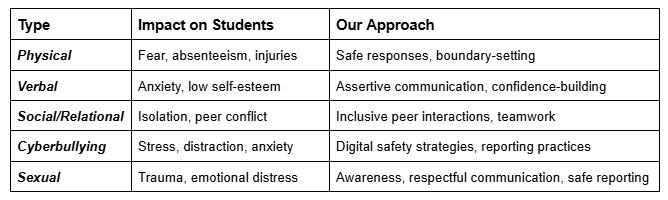
By addressing these bullying types with structured bullying prevention programs for schools and real-world strategies, we help students in Los Angeles–Long Beach–Anaheim feel safer, more confident, and better equipped to handle challenges.
How Bullying Affects Students and School Communities
Bullying impacts students, classrooms, and overall school safety. We observe how repeated incidents affect learning, social dynamics, and the broader community. Understanding these effects helps us design safety programs that reduce risks and promote inclusion.
Across the Los Angeles–Long Beach–Anaheim region, schools face diverse social and cultural dynamics, which makes structured bullying prevention and violence prevention training an important part of maintaining safe learning environments.
Academic and Emotional Impact
Bullying lowers academic performance and increases emotional stress. Students who face bullying often miss school, struggle to concentrate, and show signs of anxiety or depression.
We notice patterns such as:
Students are avoiding classes or group activities.
Reduced participation in discussions or projects.
Heightened stress affects test scores and focus.
For example, a student subjected to cyberbullying may withdraw from online learning, while another experiencing verbal harassment may struggle with homework completion. These challenges can hinder both academic growth and emotional well-being.
Social and Behavioral Consequences
Bullying disrupts peer relationships and classroom behavior. Conflicts, social exclusion, and tension among students create a challenging environment for learning.
Common examples include:
Cliques are isolating certain students.
Arguments or name-calling spilling into classrooms.
Cyberbullying is escalating offline conflicts.
Such patterns affect collaboration, teacher-student interactions, and overall school morale.
Risks to School Safety
Unaddressed bullying can escalate into violence or unsafe incidents. Without intervention, minor conflicts may grow into physical confrontations or threats.
We see outcomes like:
Hallway fights following repeated teasing.
Cyberbullying leading to in-person disputes.
Increased stress on staff and students managing conflict.
Schools that adopt trauma-informed safety education notice fewer incidents and a safer environment.
At Get Safe, our bullying prevention programs for schools focus on early identification, communication skills, and inclusive strategies to prevent escalation and support all students.
Trauma-Informed Safety Education: A Preventive Approach
Trauma-informed safety education helps us prevent bullying and other safety risks by recognizing how past trauma affects student behavior. We focus on trust, communication, and strategies that support all learners in feeling safe and understood.
Principles of Trauma-Informed Education
Trauma-informed education recognizes how students respond to stress and trauma. Students may react to bullying or conflict with Anxiety, withdrawal, or aggression.
Key principles include:
Prioritizing physical and emotional safety in classrooms.
Building trust through consistent, predictable routines.
Encouraging open communication between staff and students.
Integrating Trauma-Informed Practices into Schools
We apply trauma-informed practices through staff training and age-appropriate interventions. This allows educators to respond effectively and prevent escalation.
Practical steps include:
Training staff to recognize behavioral cues and de-escalate tension.
Implementing classroom strategies tailored to elementary, middle, and high school students.
Establishing clear reporting and support systems for all incidents.
For instance, a high school might use peer mediation programs, while an elementary school provides structured conflict resolution activities.
Benefits of Trauma-Informed Safety Education
This approach reduces bullying and promotes resilience. Students feel safer, communicate better, and engage more in learning.
We observe outcomes such as:
Lower rates of bullying and classroom disruptions.
Improved confidence and social skills among students.
Stronger, more inclusive school communities.
By addressing the root causes of behavioral challenges, trauma-informed programs help us build safer environments while supporting emotional and academic growth.
Key Components of Effective School Safety Programs
Creating a safe school environment depends on several coordinated efforts. We focus on strategies that support students, staff, and the broader school community while fostering a culture of respect and accountability. Each component contributes to building trust, improving behavior, and reducing safety incidents.
In schools throughout the Los Angeles–Long Beach–Anaheim area, these approaches are tailored to reflect local community needs, helping students feel secure, supported, and included every day.
Prevention and Awareness Programs
Prevention starts with awareness. We work with schools to organize programs that help students recognize, respond to, and prevent unsafe situations.
Key initiatives include:
Anti-bullying workshops that teach conflict management and respectful communication
Peer mentoring programs where older students guide younger peers
Student-led campaigns promoting inclusion and positive social behavior
These programs give students practical tools to support themselves and their peers, creating a safer and more inclusive school environment.
Staff and Faculty Training
Training staff strengthens the school’s safety framework. We provide workshops and scenario-based learning that prepare teachers, administrators, and support staff to respond effectively to challenging situations.
Key training elements include:
Violence prevention education tailored to school settings
Hands-on exercises simulating real-world conflicts
Ongoing refreshers to maintain confidence and consistency
For example, practicing de-escalation during a simulated verbal confrontation allows staff to apply strategies in realistic contexts.
Policies and Reporting Systems
Clear policies guide action. We help schools develop step-by-step protocols for identifying, documenting, and responding to bullying or safety concerns.
Key features include:
Transparent reporting systems for students and staff
Documentation procedures for administrative review
Defined follow-up actions to resolve incidents
A consistent process helps students and staff understand what happens after an incident is reported, building trust and accountability.
Violence Prevention Training in Schools
Bullying can escalate into violence if it is not addressed early.
Repeated bullying may increase anger, fear, or retaliation. Over time, unresolved conflicts can develop into physical fights or serious safety incidents.
Violence prevention training helps interrupt that pattern by:
Teaching students how to manage anger and frustration
Helping staff recognize early warning signs
Practicing de-escalation techniques
Reinforcing clear reporting and response protocols
When we combine violence prevention training with bullying prevention programs for schools and trauma-informed safety education, we address both the behavior and its root causes. This approach reduces the risk of escalation and supports a safer learning environment for everyone.
Family and Community Engagement
Safety extends beyond the classroom. We involve parents, guardians, and local agencies to support school programs and reinforce positive behavior outside school.
Strategies include:
Parent and guardian workshops on conflict resolution and communication
Community meetings to coordinate safety initiatives
Collaboration with local organizations for support services
Engaging families and communities strengthens the school’s culture of respect and ensures consistent messaging across environments.
By integrating these components, we build school safety programs that are practical, actionable, and supportive for everyone in the school community.
Role of Personal Safety Classes in California Schools
Personal safety classes in California play a key role in helping students and staff navigate everyday challenges safely. We provide practical skills, tailored approaches, and hands-on exercises that build confidence and promote safer school communities.
Equipping Students with Practical Skills
Students gain the tools to protect themselves and communicate effectively. Our classes teach strategies that go beyond theory and can be used in real-life situations.
Key lessons include:
Setting and respecting personal boundaries in social and classroom settings
Using assertive communication to express needs and concerns
Practicing self-advocacy in a respectful and safe manner
By practicing these skills through role-playing and guided exercises, students develop confidence and a stronger sense of control over their interactions.
Supporting Students with Intellectual and Developmental Disabilities (IDD)
Every student benefits from instruction designed to match their learning needs.We adapt lessons so students with IDD can participate fully while learning in a trauma-informed environment.
Our approach includes:
Visual aids and simplified instructions for complex concepts
Small-group activities that allow individualized attention
Repetition and hands-on practice to reinforce learning
This approach helps students build social, communication, and safety skills while feeling supported and included.
Preparing Staff for Real-World Challenges
Staff receive practical training to respond safely and effectively. Our scenario-based exercises mimic situations that can occur in schools, giving faculty the chance to practice responses without risk.
Staff training focuses on:
De-escalating conflicts before they escalate
Recognizing early warning signs of bullying or unsafe behavior
Responding consistently and calmly in high-stress situations
These exercises give staff confidence in their ability to act and model safe behaviors for students.
By combining student skill-building, specialized support for students with IDD, and staff preparedness, we create a balanced approach that promotes safety across the entire school community.

How Get Safe Supports Schools in Reducing Bullying
We work directly with schools in the Los Angeles–Long Beach–Anaheim area to provide safety programs that fit the unique needs of each community. Our focus is on practical, trauma-informed approaches that support students, staff, and families in creating safer learning environments.
Customized Programs for Every School
We adapt our curricula for different grade levels, learning abilities, and school settings. OSHA-aligned programs for elementary students include role-playing and peer interaction exercises, while high school programs focus on communication, leadership, and self-advocacy skills.
Expert-Led, Trauma-Informed Instruction
Our instructors bring years of real-world experience in law enforcement, mental health, and social services. This expertise allows us to teach strategies for preventing bullying, de-escalating conflict, and responding to incidents with care and professionalism.
Accessible and Compliant Training Solutions
Schools can choose from in-person workshops or virtual sessions that meet California safety regulations. Each option includes clear guidance, interactive learning, and resources for ongoing support, helping staff and students apply lessons consistently.
Collaboration and Support
We work closely with administrators, teachers, and parents to reinforce lessons across classrooms and homes. This coordinated approach encourages consistent expectations and stronger school communities.
Measurable Outcomes
Through program evaluations and feedback, we track reductions in bullying incidents, improved student confidence, and stronger social skills, giving schools clear evidence of progress.
By combining tailored content, expert guidance, and practical strategies, we help schools create safer environments where students feel heard, respected, and prepared to manage conflict.
Client testimonial: “Get Safe is the real deal. Their training is clear, practical, and actually sticks. The team brings so much experience, and you can tell they truly care about helping people stay safe. If you’re in need of safety training that works, this is who you call.”ByP. Campbell
Testimonials like this motivate us to continue raising the standard for school safety, violence prevention training, and every program we deliver to the communities we serve.
Take the Next Step in Building Safer Schools
Partner with Get Safe to provide trauma-informed, practical safety training that reduces bullying and strengthens school communities.Reach out to us today to discuss a program tailored for your school. Contact us at [email protected] or call (714) 834-0050 to schedule a consultation or request a training session.
Our team is ready to support your students, staff, and families in creating a safer, more confident learning environment.